
MOL KSA Iqama Huroob Check 2026: Check Huroob Status Online
MOL KSA Iqama Huroob Check helps expatriate workers verify their employment status in Saudi Arabia. Huroob commonly refers to an “Absent from Work” status recorded under Saudi labor procedures. The current authority is the Ministry of Human Resources and Social Development (MHRSD), while MOL remains a common search term from the ministry’s former name.
Workers should verify their status through the current official Saudi labor services rather than rely on outdated MOL instructions. Qiwa also provides official services for absence-related employment procedures.
How do I check my Huroob status?
Use the current MHRSD labor services and relevant Qiwa procedures to verify your employment status. The required details can depend on the service and worker category. MHRSD identifies “متغيب عن العمل” (Absent from Work) as an employment status in its labor systems.
What Is MOL KSA Iqama Huroob Check?
MOL KSA Iqama Huroob Check refers to checking an expatriate worker’s employment status in Saudi Arabia. The term combines the older MOL name with Iqama and Huroob search terms.
Workers often use this phrase when they want to know whether their record shows Huroob or Absent from Work. Current Saudi labor information comes from the Ministry of Human Resources and Social Development (MHRSD).
What Does MOL KSA Mean?
MOL stands for the Ministry of Labor. Saudi Arabia previously used this name for its labor ministry.
The ministry later became the Ministry of Human Resources and Social Development (MHRSD). MHRSD now handles many labor-related services and regulations.
You may still see MOL KSA on websites, search results, and older guides. Many expatriate workers continue using this familiar term when searching online.
Common searches include:
- MOL KSA Iqama Check
- MOL KSA Huroob Check
- MOL Iqama Check
- MOL Gov Sa Iqama Check
- MOL Huroob Status Check
These terms can refer to the same general search intent. However, you should verify current procedures through official MHRSD services.
What Does Huroob Mean?
Huroob (هروب) is the common term used for an employment-related absence report in Saudi Arabia.
Government systems may use the formal term “Absent from Work” or “متغيب عن العمل.” MHRSD uses this terminology in its current labor procedures.
In simple terms, the status indicates that the worker has an absence-related employment record.
The term Huroob remains common among expatriate workers. You may also find it described as:
- Huroob status
- Absence from work
- Absent from Work
- متغيب عن العمل
- Huroob report
- Absence report
The exact rules can vary by worker category and current Saudi labor procedures. Therefore, do not treat every Huroob case as identical.
Is Huroob the Same as an Expired Iqama?
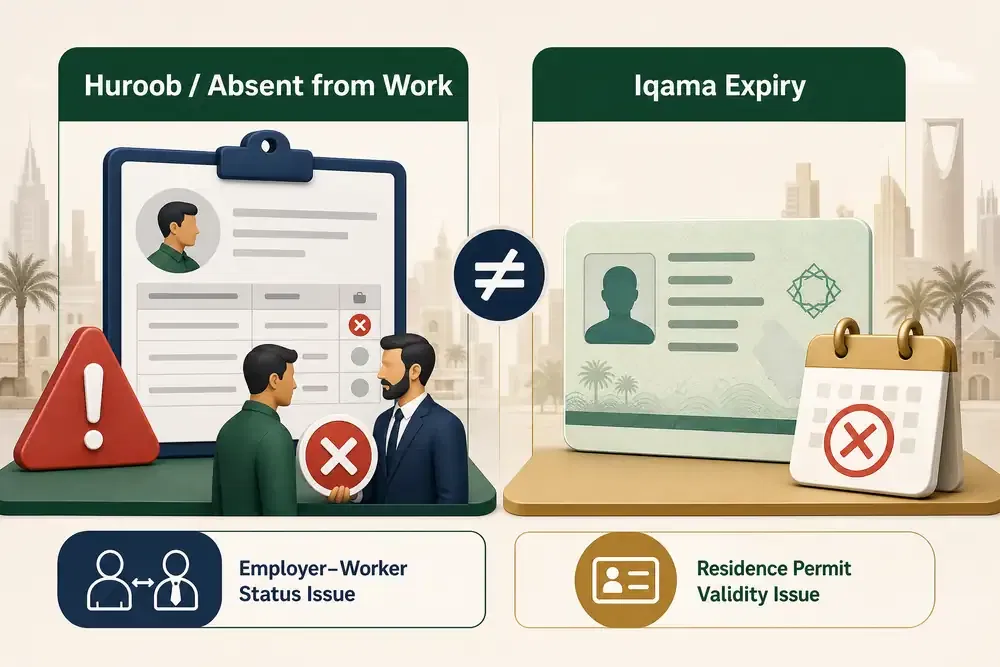
No. Huroob and Iqama expiry are different issues.
Huroob concerns an employment or absence status. Iqama expiry concerns the validity of a worker’s Saudi residence permit.
| Huroob | Iqama Expiry |
|---|---|
| Employment-related status | Residency validity issue |
| Linked to absence from work | Linked to an expired residence permit |
| Involves an employer or labor process | Concerns the residence document |
| Uses the term Absent from Work | Concerns Iqama validity |
How to Check MOL KSA Iqama Huroob Status Online
The safest approach is to use the current MHRSD and Qiwa services. Avoid relying on old MOL instructions because the ministry has changed its digital service structure.
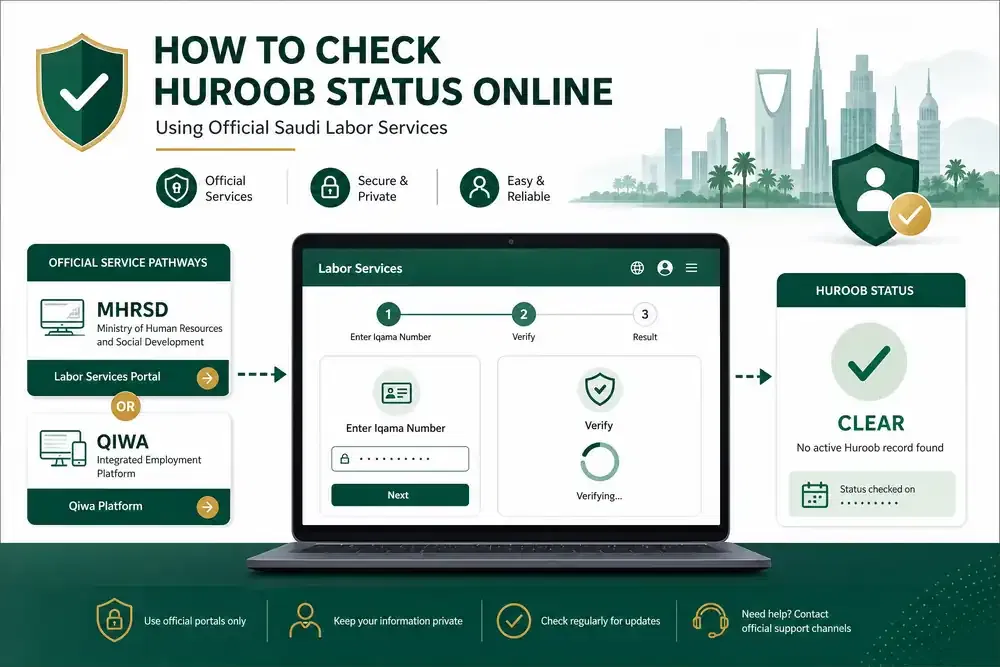
The exact inquiry method can vary by worker category and service. MHRSD currently documents worker-data searches using an Iqama or border number for authorized users.
Step 1: Open the Correct Official Saudi Service
Start with the current Ministry of Human Resources and Social Development (MHRSD) services.
For employment-related Huroob procedures, Qiwa also plays an important role. MHRSD directs several absence-from-work processes through Qiwa.
Do not assume an old MOL Gov Sa page remains the correct option. The term “MOL” remains popular, but MHRSD now manages the ministry’s labor services.
For worker records, MHRSD lists its View/Update Worker Data service. That service uses an Iqama or border number and requires authorized establishment access.
Step 2: Enter the Required Information
The information depends on the specific official service.
An eligible worker record may use:
- Iqama number
- Border number
- Worker identification details
- Other information requested by the selected service
MHRSD confirms that its worker-data service supports searches using an Iqama or border number.
Do not assume that every MHRSD or Qiwa service accepts a passport number. The available identifiers depend on the service.
The same rule applies to nationality details. Enter them only when the official form requests them.
Step 3: Complete the Verification
Follow the verification instructions shown on the official page.
The service may require a security check before displaying information. This can include a CAPTCHA or another verification step.
Enter the requested details exactly as shown on your official records.
If the verification fails, refresh the page and try again. Avoid using unofficial websites that ask for unnecessary personal information.
Step 4: Submit the Inquiry
Review your information before submitting the request.
Select the button shown by the official service to search or retrieve the worker record.
The exact button name can vary between MHRSD services.
If the service requires establishment authorization, an individual worker may not have direct access to that specific inquiry. MHRSD identifies its worker-data service as available to an authorized establishment representative.
How to Check Huroob Status Using Iqama Number
Your Iqama number identifies your Saudi resident record. It can help connect your identity with employment and residency records held across government systems.
For Huroob checks, use the current official service that supports your worker category. MHRSD provides employment-related digital services, while Qiwa handles several labor processes for establishments.
What Is an Iqama Number?
An Iqama number is the identification number linked to a resident’s Saudi residence permit.
Workers commonly use it when accessing Saudi government services. The number can identify the worker within relevant employment and residency systems.
MHRSD also supports worker-related services that use an Iqama or border number. However, access can depend on the service and user type.
Where Can You Use Your Iqama Number?
Your Iqama number can identify your record across relevant Saudi services.
For Huroob-related matters, the correct platform depends on the service involved. MHRSD and Qiwa handle important employment-related processes.
What If No Huroob Record Appears?
A missing result does not automatically mean you have no Huroob status.
First, check that you entered the correct Iqama number. Then confirm that you used the correct official service.
Also consider your worker category. Some services target establishments rather than individual workers. MHRSD’s worker-data service, for example, requires authorized access.
Can You Check Huroob Without Absher?
Absher is not automatically required for every Huroob-related process. The required platform depends on the specific service, worker category, and action you need.
MHRSD manages labor-related services, while Qiwa supports several employment procedures. Absher also provides separate services connected with residents and workers.
Is Absher Required to Check Huroob?
Do not treat Absher as the universal Huroob-check platform.
Official sources show that Absher provides services involving worker and resident records. For example, Absher Business includes Iqama services for establishment owners.
Can You Check Huroob Through Qiwa?
Qiwa is an important Saudi labor platform for employment-related services. However, you should not treat every Qiwa service as a direct Huroob checker.
The correct service depends on your worker category and the action you need. MHRSD uses Qiwa for several procedures involving expatriate workers and employment relationships.
What Does Qiwa Show?
The information available through Qiwa depends on the service and your account access.
Qiwa can provide employment-related information connected with services such as contracts and worker transfers. It does not mean that every worker can view every labor record through one Qiwa page.
What Is the Difference Between Huroob and “Absent From Work”?
Huroob (هروب) is the common term expatriates use for an absence-related work status. “Absent from Work” (متغيب عن العمل) is the formal wording used by Saudi government systems and MHRSD.
The two terms often describe the same general issue in everyday searches. However, Huroob is not the formal status name shown in every government record.
Why Does Huroob Get Registered in Saudi Arabia?
Huroob refers to an absence-related employment status under Saudi labor procedures. The formal government terminology often uses “Absent from Work” (متغيب عن العمل).
An employer may report a worker’s absence when the applicable legal conditions and procedures are met. However, not every absence automatically creates a Huroob status.
The process depends on factors such as the worker’s category, employment relationship, and current MHRSD rules. MHRSD and Qiwa provide specific procedures for different employment situations.
Absence From Work
An employer may take action when a worker stops working without following the applicable employment process.
The employer must follow the required reporting procedure. The report does not simply result from an employer’s informal statement.
Current procedures also distinguish between different stages of an employment relationship.
Employment Relationship Termination
An employment relationship can end through different legal processes.
A worker’s status may change when the employment relationship ends or becomes interrupted. MHRSD’s procedures explain how certain workers can move from منقطع عن العمل (Work Interrupted) to متغيب عن العمل (Absent from Work) after the applicable period.
This does not mean every terminated employment relationship becomes Huroob.
Employer Procedures Matter
Employers must use the applicable official process when reporting an absent worker.
For professional workers, MHRSD uses Qiwa for several employment-related procedures. The exact process depends on the worker’s situation.
Therefore, workers should not rely on claims that an employer can place Huroob on an Iqama without following official requirements.
Contract-Related Situations
Employment contracts can affect the process.
The worker’s contract status, employment relationship, and applicable labor rules can determine which procedure applies.
This matters because Saudi labor systems now use several digital processes for employment relationships. Qiwa supports services involving contracts, workers, and employment transfers.
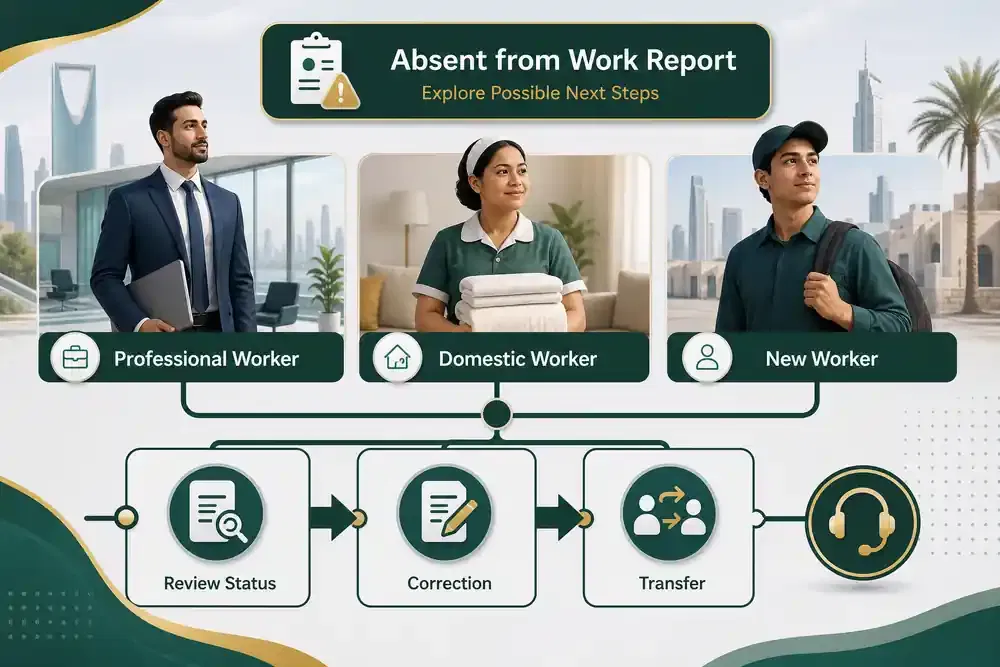
Professional Workers and Domestic Workers
Saudi Arabia does not use one identical process for every worker category.
Professional workers fall under MHRSD labor procedures. Several related services operate through Qiwa.
Domestic workers follow separate procedures and services. MHRSD directs domestic-worker employment matters through the relevant domestic-worker systems.
What Happens After an Absent-from-Work Report?
An Absent from Work report can change the worker’s employment status.
The next steps depend on the worker’s category, report status, and current Saudi regulations. MHRSD provides specific procedures for workers affected by absence-related statuses.
Employment Status Can Change
MHRSD uses both منقطع عن العمل and متغيب عن العمل in its procedures.
In certain cases, a worker can first receive a Work Interrupted status. The record can later change to Absent from Work after the applicable period.
This means the status can change as the official process progresses.
Correction Options May Apply
Some workers may qualify for procedures that correct or regularize their employment status.
The available option depends on:
- Worker category
- Employment history
- Date of the report
- Current status
- Applicable MHRSD rules
- Eligibility under any active initiative
Do not assume every worker receives the same correction option.
Transfer to Another Employer
Some workers with absence-related statuses may qualify for an employment transfer.
MHRSD currently documents procedures for transferring certain expatriate workers under specific conditions. Qiwa supports relevant employee-transfer services.
Eligibility can depend on the worker’s status and the applicable MHRSD procedure.
Therefore, a Huroob status does not automatically guarantee or prevent every transfer option.
Final Exit Options
Final-exit procedures can also depend on the worker’s current status and applicable Saudi rules.
Do not assume that an Absent from Work status always allows or blocks a final exit.
Workers should verify their current status through official government services before making decisions.
Government-System Updates
Employment records can change after an employer submits a report or completes another official procedure.
Updates can also depend on system processing and the applicable employment process.
How Long Do You Have to Correct an Absent-from-Work Status?
There is no single correction deadline that applies to every Huroob case.
The applicable timeline can depend on the worker’s circumstances and the current MHRSD procedure.
Consider these factors before relying on a deadline:
- Worker category
- Employment relationship
- Date of the absence report
- Current employment status
- Applicable Saudi regulations
- Active MHRSD initiatives
What About the 60-Day Period?
MHRSD has announced specific regularization procedures for eligible professional workers.
One MHRSD initiative began on September 18, 2025 and provided additional time for eligible workers to correct their status under stated conditions.
That initiative does not justify a universal claim that every worker has 60 days to fix Huroob.
The correct period depends on the applicable procedure.
Always check the latest MHRSD announcement before relying on a deadline.
This approach matters because Saudi labor rules and regularization initiatives can change.
Can Huroob Be Removed or Cancelled?
A Huroob or Absent from Work status may have correction options in certain circumstances.
However, the available process depends on the worker’s case and current regulations.
Can an Employer Cancel a Huroob Report?
Do not assume that every employer can cancel an absence report at any time.
The employer must follow the procedure available for the specific worker and report.
MHRSD and Qiwa provide official processes for employment-related actions. The available option can depend on the report’s status and timing.
If an employer claims that a cancellation is impossible, ask for the reason and verify it through MHRSD.
Can a Worker Challenge an Incorrect Report?
A worker who believes an absence report is incorrect should use an official labor complaint or dispute channel.
Keep evidence that supports your employment relationship.
Useful records may include:
- Employment contract
- Salary records
- Attendance records
- Employer communications
- Work-related documents
- Relevant government records
Do not rely only on screenshots from unofficial websites.
The appropriate complaint route depends on the worker’s case and the current MHRSD process.
Can a Worker Transfer to Another Employer?
Some workers with existing absence reports may qualify for transfer procedures.
MHRSD has published procedures covering certain expatriate workers with absence-related statuses.
Qiwa also provides employee-transfer services for eligible workers.
However, Huroob does not automatically make every worker eligible for transfer.
Eligibility can depend on the worker’s category, employment history, report date, and the specific MHRSD initiative or regulation.
Huroob and Job Transfer
A Huroob status can affect an expatriate worker’s employment options, but it does not create one transfer rule for everyone.
The available transfer route depends on the worker’s status, employment history, and current MHRSD procedures. Qiwa handles several official employee-transfer services for eligible expatriate workers.
Normal Transfer
A normal employee transfer follows the standard Saudi labor process.
Eligible employers can submit transfer requests through Qiwa. The worker and receiving employer must meet the applicable requirements.
A Huroob status can change which transfer rules apply.
Therefore, do not assume that the standard transfer process applies to every worker with an absence report.
Transfer Under Special Regularization Procedures
MHRSD has introduced specific procedures for some workers with absence-related statuses.
These procedures can allow eligible workers to correct their employment situation or transfer to another employer. MHRSD’s published procedures include cases involving workers with متغيب عن العمل status.
Eligibility depends on the applicable initiative and the worker’s circumstances.
Qiwa’s Role in Huroob Transfer
Qiwa is important for many expatriate employment-transfer procedures.
The receiving employer can use Qiwa to start the applicable transfer process. The platform then applies the requirements for that service.
However, Qiwa does not mean every worker with Huroob automatically qualifies for transfer.
Employer Requirements
The receiving employer may need to meet requirements before starting a transfer.
These can include conditions related to:
- Employer eligibility
- Establishment status
- Compliance requirements
- Worker information
- Transfer conditions
- Applicable MHRSD rules
The exact requirements can change with the relevant procedure.
Worker Requirements
The worker’s eligibility can also depend on:
- Current employment status
- Worker category
- Existing absence report
- Employment history
- Report date
- Applicable regularization program
Huroob and Final Exit
A Huroob status can affect how a worker handles employment and residency procedures.
However, you should not assume that every Huroob case follows the same final-exit process.
Does Huroob Affect Final Exit?
The effect depends on the worker’s current status and applicable Saudi regulations.
Final-exit services involve Saudi government systems and may depend on the worker’s residency and employment records.
Therefore, check your current status before starting a final-exit procedure.
Normal Final Exit vs Special Situations
A worker with a normal employment record may follow the standard final-exit process.
A worker with an Absent from Work status may face a different procedure.
Special regularization initiatives can also create additional options for eligible workers.
MHRSD has published specific initiatives for correcting the status of eligible absent professional workers.
Do not rely on a generic Huroob article for your final-exit eligibility.
Verify Your Status First
Before making travel or employment decisions:
- Verify your employment status.
- Check your Iqama information.
- Review the applicable MHRSD procedure.
- Check Qiwa when the case involves employment action.
- Confirm final-exit requirements through the responsible official service.
What Should You Do If Your Status Shows “Absent from Work”?
An Absent from Work result does not mean you should immediately take the same action as another worker.
First, confirm the record and identify the correct procedure.
Follow These Steps
1. Save a screenshot of the result.
Keep a copy showing the status and date.
2. Verify your Iqama details.
Check your Iqama number and other identifying information.
3. Review your employment record.
Check the relevant MHRSD or Qiwa information available to you.
4. Contact your employer when appropriate.
Ask why the absence report appears on your record.
Keep written communication when possible.
5. Review Qiwa.
Check whether the case involves an employment contract, transfer, or another labor procedure.
6. Contact MHRSD through an official channel.
Ask for clarification when the record appears incorrect or unclear.
7. Seek qualified labor assistance for disputed cases.
A labor professional can help when the employer disputes your claim or the case involves a formal complaint.
Common Problems When Checking Huroob
Huroob inquiries do not always return a clear result.
The problem may come from the service, worker category, entered information, or system status.
Huroob Check Shows No Record
A missing result does not automatically mean you have no Huroob status.
Possible reasons include:
- Incorrect information
- Wrong service
- Service availability issue
- Data synchronization delay
- Worker category mismatch
- Restricted service access
What to do: Verify your details and use the official service that applies to your worker category.
Iqama Number Is Not Accepted
Check every digit before submitting the inquiry.
Do not add spaces or extra characters unless the official form requires them.
If the number remains invalid, confirm that the selected service accepts an Iqama number.
CAPTCHA Is Not Working
Try these basic steps:
- Refresh the page.
- Reload the verification challenge.
- Clear temporary browser data.
- Try another supported browser.
- Check your internet connection.
Avoid repeated submissions if the official service continues rejecting the verification.
Website Is Not Opening
The problem may come from temporary service maintenance or browser issues.
Try the official service again later.
Do not switch to an unofficial Huroob checker simply because the government website is temporarily unavailable.
Huroob Status Has Not Updated
Government records may require processing after an employment action.
Check the status again after the relevant procedure completes.
If the delay continues, contact the responsible official service.
Qiwa and Another System Show Different Information
Different platforms can serve different purposes.
One system may show employment information while another handles residency services.
Do not assume the difference proves that one record is wrong.
MOL KSA vs MHRSD vs Qiwa vs Absher
These names often appear together in Huroob searches.
They do not represent the same service.
| Platform | What users associate it with |
|---|---|
| MOL | Former Ministry of Labor terminology |
| MHRSD | Current Ministry of Human Resources and Social Development |
| Qiwa | Digital labor and employment services |
| Absher | Individual government services |
| Muqeem | Residency and employer-related services |
Which Platform Should You Use?
MOL:
Use this term mainly when searching for older information.
MHRSD:
Use MHRSD when checking current Saudi labor rules and ministry procedures.
Qiwa:
Use Qiwa for applicable employment services, including certain employee-transfer processes.
Absher:
Use Absher for services provided through its individual or business government channels.
Muqeem:
Use Muqeem for applicable employer and residency-related services.
The correct platform depends on the task.
For example, Huroob concerns employment status, while Iqama validity concerns residency status.
Huroob vs Iqama Status vs Work Permit Status
These terms describe different parts of a worker’s Saudi record.
Huroob Status
Huroob is the common term for an absence-related employment status.
MHRSD uses متغيب عن العمل (Absent from Work) in its official procedures.
Iqama Validity
Iqama validity shows whether the worker’s residence permit remains valid.
An expired Iqama does not automatically mean the worker has Huroob.
Work Permit Status
A work permit relates to the worker’s authorization to work under Saudi labor rules.
It forms part of the employment and labor framework.
A work-permit issue and Huroob status are not automatically the same.
Employment Status
Employment status describes the worker’s relationship with the employer.
It can include different statuses depending on the official system and employment process.
Visa Status
Visa status concerns the worker’s visa or immigration-related record.
It differs from both employment status and Iqama validity.
| Record | What it mainly concerns |
|---|---|
| Huroob | Absence-related employment status |
| Iqama | Residency permit validity |
| Work Permit | Legal work authorization |
| Employment Status | Worker-employer relationship |
| Visa Status | Visa or immigration record |
Can I Check Huroob by Passport Number?
A passport number can identify a foreign national, but not every Huroob service supports passport-based searches.
The available search fields depend on the official service.
MHRSD documents services that use identifiers such as the Iqama or border number.
Therefore, do not assume that a passport number works across every MHRSD, Qiwa, Absher, or other Saudi service.
Is Nationality Required?
Some government services may request nationality with an identification number.
Other services may use different worker details.
Enter nationality only when the official service requests it.
What If Passport Search Fails?
Try the identification method supported by the official service.
If the service supports an Iqama number Check, use that option when available.
If no suitable option works, contact the responsible official service rather than using an unofficial checker.
Can I Check Huroob by Border Number?
Some MHRSD worker services support searches using a border number.
MHRSD specifically identifies the Iqama and border number as search identifiers for its worker-data service.
This does not mean every Huroob service accepts a border number.
How Does Border Number Huroob Check Work?
If the official service provides a border number field:
- Enter the correct border number.
- Complete the required verification.
- Submit the inquiry.
- Review the returned worker information.
Huroob Check for Different Worker Categories
Huroob procedures can differ between worker categories.
This distinction helps prevent incorrect advice.
Professional Expatriate Workers
Professional expatriate workers fall under MHRSD labor procedures.
Qiwa supports several employment services involving these workers, including applicable transfer procedures.
Some current MHRSD initiatives also target eligible professional workers with absence-related statuses.
Domestic Workers
Domestic workers follow different employment procedures.
Do not apply professional-worker Huroob rules to domestic workers without checking the relevant official process.
MHRSD provides separate channels and procedures for domestic-worker employment matters.
New Workers
New workers can have different employment records from established workers.
Their status may depend on:
- Employment registration
- Contract status
- Worker arrival
- Employer procedures
- Applicable labor rules
Check the worker record before assuming an absence status exists.
Workers With Existing Absence Reports
Workers with an existing Absent from Work status may have specific correction or transfer options.
MHRSD has published procedures for certain affected workers.
Latest Saudi Huroob Rules in 2026
Saudi Huroob rules can change through new regulations, procedures, and temporary initiatives.
Therefore, this section should receive regular updates.
Current MHRSD Announcements
MHRSD remains the key government authority for Saudi labor regulations.
Its official announcements should take priority over older MOL guides.
Current Qiwa Procedures
Qiwa supports several current employment procedures for expatriate workers.
Employee-transfer services are among the labor processes handled through Qiwa.
Current Regularization Initiatives
MHRSD has announced regularization measures for eligible workers with absence-related statuses.
One initiative for eligible professional workers started on September 18, 2025. It included specific conditions and correction procedures.
Do not treat that initiative as a permanent rule for every worker.
Changes to Absence-from-Work Procedures
MHRSD’s current procedures distinguish between different employment statuses.
These include منقطع عن العمل and متغيب عن العمل in applicable processes.
Important Dates
Dates matter when determining eligibility for a specific initiative.
The relevant date can include:
- Absence report date
- Employment status date
- Initiative start date
- Correction period
- Current application date
Always verify the latest official announcement before relying on a deadline.
Who Qualifies?
Eligibility depends on the exact MHRSD procedure.
Relevant factors can include:
- Worker category
- Employment history
- Current status
- Absence report
- Employer status
- Initiative conditions
Frequently Asked Questions
What Is MOL KSA Iqama Huroob Check?
It refers to checking whether an expatriate worker has an absence-related employment status in Saudi Arabia. MOL is the former ministry terminology, while MHRSD is the current ministry.
How Can I Check My Huroob Status Online?
Use the current official Saudi labor service that applies to your worker category. MHRSD and Qiwa handle different employment-related services.
Can I Check Huroob Using My Iqama Number?
Some official worker services support an Iqama number. MHRSD also documents worker-data services using Iqama or border numbers.
Can I Check Huroob Without Absher?
Absher is not the universal platform for every Huroob-related service. The correct route depends on the specific MHRSD, Qiwa, or other government service.
Can I Check Huroob Through Qiwa?
Qiwa handles several employment procedures, including applicable worker-transfer services. However, do not assume every Qiwa account provides a direct Huroob checker.
What Does “Absent from Work” Mean?
It is the formal English term used for متغيب عن العمل in relevant MHRSD procedures. Workers commonly call this status Huroob.
Is Huroob the Same as an Expired Iqama?
No. Huroob concerns an employment-related absence status. Iqama expiry concerns the validity of the residence permit.
Can I Check Huroob Using My Passport Number?
Only if the specific official service supports passport-based identification. Do not assume passport searches work across every Saudi government platform.
Can I Check Huroob Using My Border Number?
Some MHRSD worker services support border-number searches. The available identifier depends on the specific service.
What Should I Do If My Iqama Shows Huroob?
Save the result, verify your details, review your employment record, and contact the employer when appropriate. Use official MHRSD or Qiwa channels for the next step.
Can Huroob Be Removed?
Some workers may qualify for correction or regularization procedures. The available option depends on the worker’s category, status, and current MHRSD rules.
Can I Transfer to Another Employer With Huroob?
Some workers may qualify for transfer under specific MHRSD procedures or initiatives. Eligibility is not automatic and depends on the worker’s circumstances.